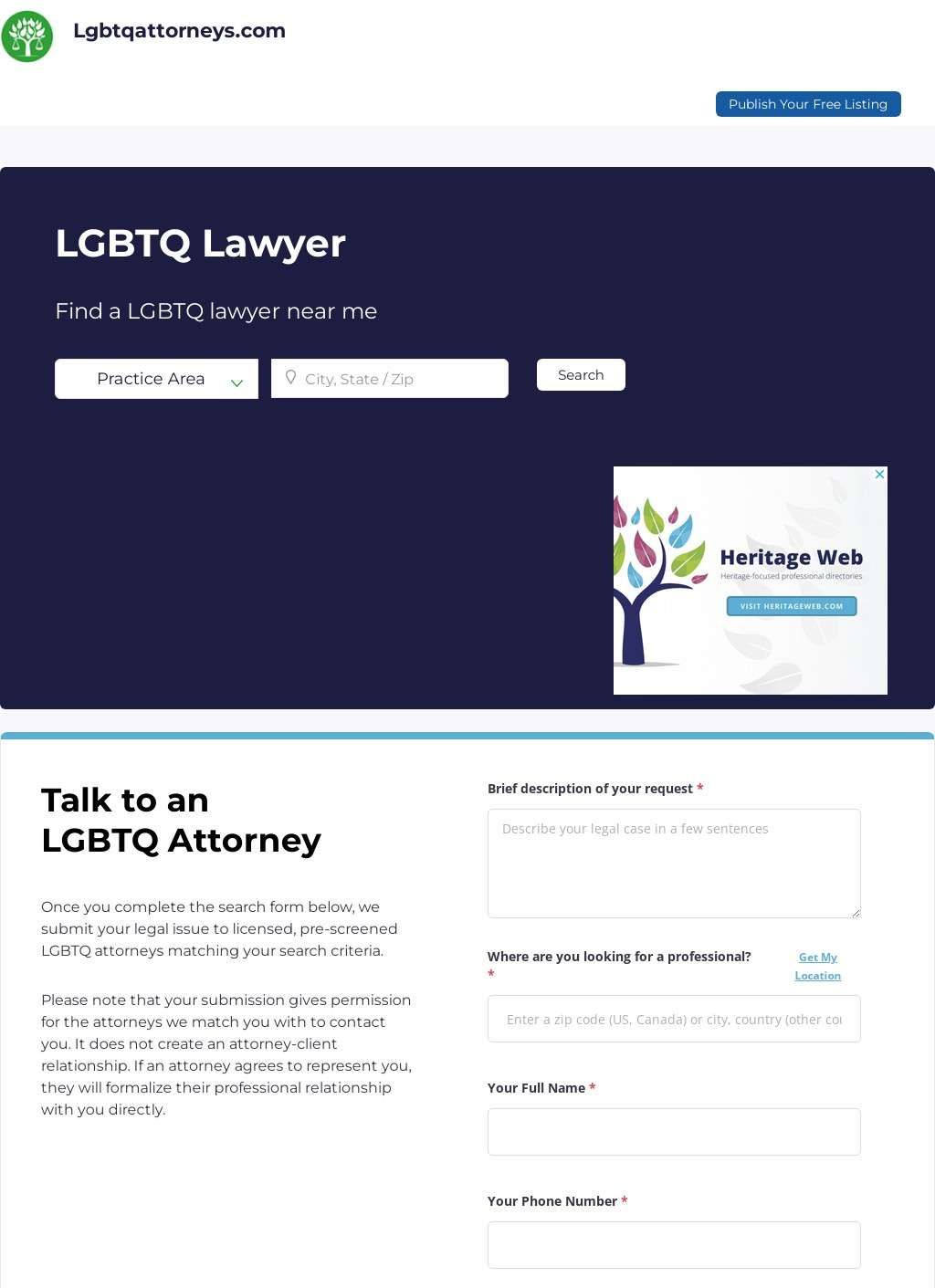
People who want an attorney who will not make their identity an issue have somewhere to start: lgbtqattorneys.com, a referral and matching service that connects people across the United States with lawyers vetted for being LGBTQ-affirming. You fill in your legal problem and your location, the platform passes that to attorneys who fit, and those attorneys reach out directly. It is a narrow promise, and the site keeps its focus on it.
The matching runs on two browsing paths. You can go by practice area or by location, drilling down to state and city. The practice area list runs past 50 specialties: family law, immigration, criminal defense, personal injury, business law, civil rights, DUI and DWI, bankruptcy, intellectual property, asylum, and EB-5 investment visas. That last one is telling. A directory that bothers to carry EB-5 alongside everyday needs is reaching for people with genuinely complicated situations, including many that go well beyond a routine divorce or traffic case.
What the platform offers beyond a search box
One claim on the site is worth taking seriously. LGBTQ Lawyers says it checks each attorney's license standing with state licensing agencies every year. Annual verification is a meaningful filter. A referral service is only as good as whether the lawyer on the other end is in good standing, and plenty of listing sites collect names once and never look again. A yearly re-check, taken at face value, puts LGBTQ Lawyers in a stronger position than a site that builds its roster once and moves on.
There is more to look at than a search box. The site runs individual attorney spotlight profiles showing experience levels and areas of concentration, so a user can read something about a specific lawyer before deciding. Messaging goes through the platform itself, which means an initial approach can stay inside the system before any phone numbers change hands. A newsletter signup sits there for people who want to track the service over time. None of these are original ideas, but together they make the experience feel like a working tool instead of a bare intake form.
The operator does not hide who runs the show, at least not entirely. The help system links over to heritageweb.com, which indicates that LGBTQ Lawyers is one property under the Heritage Web brand. That parent-company breadcrumb is useful context. It tells you the site is part of a wider operation that builds niche directories, and that is more grounding than an anonymous domain with no ownership trail.
Worth flagging plainly: the platform spells out that submitting the form does not create an attorney-client relationship. Formal engagement is a separate step, worked out directly between user and attorney. That is the correct and honest thing to say, and the fact that LGBTQ Lawyers states it openly rather than letting people assume otherwise is a point in its favor. Anyone who has dealt with legal intake knows how easily that line gets blurred.
The footer carries a contact page link, so a route to the operator does exist. What the site does not display prominently is a phone number, an address, or any direct line up front. Reaching whoever runs LGBTQ Lawyers means scrolling to the footer and clicking through. That is a minor friction and not a dealbreaker, especially for a matching service where the contact you actually want is the attorney. A phone number or address visible up front would read as more open.
On reputation, the picture is quiet. A search for outside opinion on LGBTQ Lawyers turns up the directory's own location pages and a scatter of unrelated competing law firms, but no Google, Trustpilot, BBB, or Yelp ratings for LGBTQ Lawyers as a service. That absence is not the same as a bad word. It points to a younger or lower-profile platform that has not yet accumulated public feedback. A cautious user might lean on the annual license verification and the visible Heritage Web connection as sturdier markers, since those are concrete facts rather than reputation scores that can take years to build.
The promise of LGBTQ Lawyers is specific and the structure backs it: a focused pool of affirming lawyers, browsing by issue or place, profiles to read before messaging, and a verification habit that most casual listing sites skip. The honesty about what a form submission does and does not do is refreshing. The modest contact display and the absence of third-party review ratings keep the verdict measured. Those gaps sit small next to the practical value of a curated, license-checked match for people choosing a lawyer partly on the basis of who will treat them with respect.