The United States has produced a wide range of architectural styles over the centuries, and many of them still shape the look of the country today. From handsome homes (some of which you can buy yourself, through a flat fee MLS service) to historic college campuses to the Capitol itself, these buildings show how architects took liberties and pushed their craft forward. Reading them is a small course in American history, since each style carries the tastes and ambitions of the people who built it.
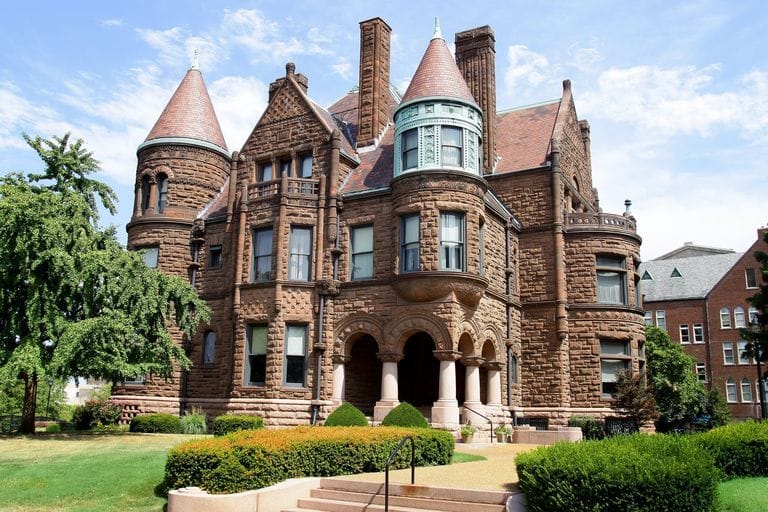
Romanesque revival
Common in churches, synagogues, and older college campuses, this style reached the United States in the mid 19th century, with much of its inspiration drawn from ancient Roman structures. It did not gain real popularity, though, until the American architect Henry Hobson Richardson championed it in the 1870s and 80s. His projects included the State Asylum for the Insane (1870-72) in Buffalo, New York, the Brattle Square (1870-72) and Trinity (1872-77) churches in Boston, and a set of community libraries, suburban railroad stations, private houses, and other commercial and civic buildings. Over his career he won a long list of awards and honors for his Romanesque revival work.
Romanesque revival buildings share several key traits:
- wide, rounded arches
- short and wide columns
- pilasters that act as decorative columns
- pointed towers
- richly varied rustication
Today you find Romanesque revival buildings mostly in urban and suburban areas, and its influence is especially pronounced in Pennsylvania. The heavy stone and rounded arches read as solid and permanent, which is one reason banks, courthouses, and libraries favored the look. If you have ever felt reassured walking into an old civic building, part of that feeling comes from the architecture doing its job.
Italianate
As the name suggests, Italianate architecture borrows from 16th-century Italian Renaissance design. The style first appeared in Britain around 1802 through John Nash, the English architect responsible for much of the layout of Regency London, who built Cronkhill in Shropshire. That small country house is generally accepted as the first Italianate villa in England. The style did not stay in England, however. It spread to the United States through the architect Alexander Jackson Davis, who gave it a following here.
Davis featured his Italianate home designs in two books, Cottage Residences (1842) and The Architecture of Country Houses (1850). Designers and ordinary readers alike picked them up, and the books set off a wave of Italianate-inspired houses across the country. This is worth pausing on: a printed pattern book carried a style across an ocean and into thousands of towns. The mechanics have changed, but the pattern has not. David Meerman Scott, in The New Rules of Marketing and PR (2022), argues that the web replaced the old model of buying attention with the ability to earn it by publishing useful material that people find when they go looking. A builder in 1850 who wanted work reached homeowners through a well-circulated book. A builder today reaches them by being visible where people search and browse.
Italianate buildings share several key traits:
- 2 or 3 stories, rarely 1
- Low-pitched roof, overhanging eaves.
- Cupola or large decorative brackets under an ornamental cornice
- Tall, narrow windows (typically on commercial buildings)
- Elaborate wrap-around porch with decorative Italianate double columns
Today you can see Italianate architecture in the Lewis F. Powell, Jr. U.S. Courthouse Annex in Richmond, VA and the Pioneer Courthouse in Portland, OR.

Neoclassical
Neoclassical architecture revives the classical orders of Greek and Roman building, and it flourished during the 18th and 19th centuries. It was built on the principles of classical antiquity, on Vitruvian rules, and on the work of the Italian architect Andrea Palladio.
The earliest neoclassical work sat close to the Baroque and set out to correct the flamboyance of that earlier style. This was clear in England, where a number of buildings drew on the style, among them St Paul’s Cathedral, the Royal Observatory in Greenwich, and the Royal Chelsea Hospital.
Neoclassicism came to America through the founding fathers and their fascination with ancient Rome. Rome was the only real example of a major republic at the time, and because they held similar hopes for the young United States, they looked to the culture around it. The nation filled with Roman-styled art and architecture as a result.
Neoclassical buildings share several key traits:
- Clean, geometric emphasis
- Restrained decoration and minimal ornamentation
- Free standing columns
- Roof is usually flat and horizontal, visible from the ground
- Massive structure
A major example of American neoclassicism today sits on Capitol Hill, where the U.S. Supreme Court Building remains a clear case of the style. The choice was deliberate. Columns and pediments were meant to link the new republic to Rome in the mind of anyone who looked, which is a reminder that architecture communicates before you read a single word about it.
Colonial
American Colonial architecture belongs to the colonial period of the United States, an era that ran from the start of colonization in the early 16th century up to incorporation and drew on a mix of cultures from Germany, France, Spain, and Latin America. Families arrived carrying their own traditions and building styles, so the new homes were highly varied. Covering all of them (French colonial, Dutch colonial, Spanish colonial, and more) would take a separate article, so here we will focus on Georgian.
The Georgian style has a long history in the United States and remains one of the most popular and enduring. It is usually tied to the reigns of England’s King George I to III, though the English architect Sir Christopher Wren pioneered the movement.
Georgian Colonial buildings share several key traits:
- Multi-pane windows
- Side-gabled or hipped roof
- Stone or brick walls
- Pediment or crown pilasters at front entry
- Cornice with dentils
Many cities that once held the finest Georgian buildings have replaced them with newer development, but examples still stand in seaboard cities such as Annapolis and Williamsburg, where slower local economies spared them from demolition. That is a familiar story in preservation: buildings often survive not because anyone protected them but because no one had the money or reason to tear them down.
Reading a building, and finding one to work on
Once you can name a few of these styles, houses stop looking generic. A low-pitched roof with heavy brackets is Italianate. A symmetrical brick front with multi-pane windows is Georgian. Wide stone arches point to Romanesque revival. That vocabulary is useful whether you are buying, restoring, or simply walking your neighborhood with fresh eyes.
It is also useful when you need help. Period homes call for trades who understand old materials and detailing, and the hard part is often finding a competent one you can trust. Rachel Botsman, in Who Can You Trust? (2017), describes a shift toward what she calls distributed trust, where ratings, reviews, and platform reputation let people extend confidence to businesses and specialists they have never met. For a restoration mason or a Georgian window specialist, being findable in curated, well-organized places is often what turns local expertise into steady work. If you own one of these older homes, start by learning its style, then look for people who list that specialty plainly and have a track record you can check.
