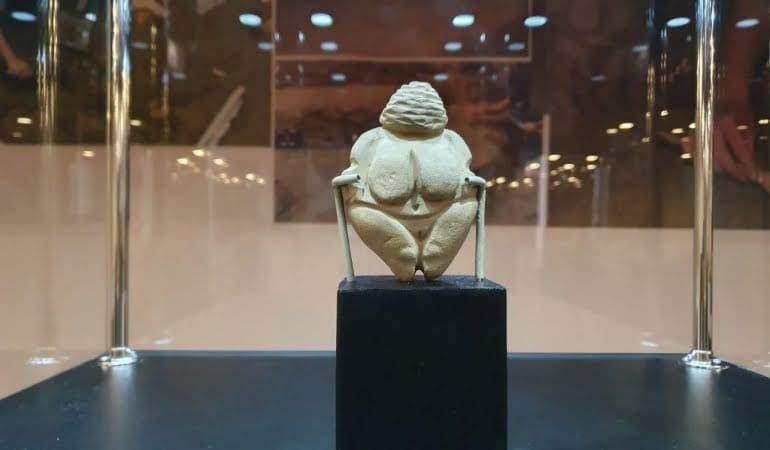
A Romanian high school student made a remarkable discovery this year: a statuette more than 17,200 years old, the only intact example found anywhere in the world in the past 100 years. It is the most important paleolithic statue in Romania and in south-east Europe, and its story combines careful archaeology with a lucky moment during a summer of floods.
CHILDREN NEWS tells you where you can see it and where you can find its “sisters.” Across Europe, many such statues have been discovered over the years. They were generically called “Venus,” and the name of the town they come from is added to identify each one. The one found here is “from Piatra Neamt.” Its best known sister is Austrian, the “Venus from Willendorf.”
What the statuette looks like
Made of sandstone, the “Venus from Piatra Neamt” measures only 10 cm. It has no facial features, but a kind of “hairstyle” covers the face. That face is often called an “alien face,” and the pictures show why. Other Venus figures look similar, with a hat or a “helmet” carrying a pattern over the place where the face would be. This is a recurring choice across the group rather than an accident of one carver, which is part of what makes the pattern interesting to researchers.
How it was found
The statuette turned up in Piatra Neamt on June 21st this summer. The researchers Marin Carciumaru, Elena Cristina Nittu and their team were working in an area near the city, ground that had been badly affected by floods in the second half of June. During the flooding, the archaeologists reasoned that the moving water might expose material that would otherwise stay buried, so they used the conditions to their advantage.
The first person to spot the statuette in the mud and pick it up was a 19-year-old student, Andrei Smeu. Andrei, who attends the “Petru Rares” National College in Piatra Neamt, was helping the archaeologists in his free time. “I found a statue! It looks like Willendorf! She has a hairstyle,” Andrei exclaimed, according to Libertatea.ro.
The professor explained why figures like this one carry meaning. “She has a certain symbolic value, those that are rendered in this opulent form, that is, the highly developed breasts, buttocks, and especially the fact that there are no details on the head, so only those anatomical parts of the body that are related to fertility, we he thinks that they were a symbol of fertility, of the protective mother of the respective clan. There are slender statues that have no connection with this idea and in the end the last hypotheses lead to the idea that the sculptor of that period carved the model in front of him, slimmer less slender,” says the professor.
How the age was established
The statue’s age, about 17,200 years, was confirmed in America through analyses carried out at one of the best laboratories in the world, Beta Analytic in the USA. The same result came from a laboratory in Magurele. The statuette was dated using Carbon 14, the standard method for organic material of this period, which measures how much of a radioactive form of carbon remains and works back to an approximate date. Having two independent laboratories reach the same figure gives the result more weight than a single test would.
The statuette is part of the Romanian Treasure and can now be seen at the Museum of Human Evolution and Technology in Paleolithic in Targoviste. It may be a kind of ancient religious object that was worshipped for reasons we can only guess at.
Its Austrian sister
The most famous sister of the Piatra Neamt figure sits in Vienna. Nicknamed “Venus from Willendorf” after the place where it was found, that statue is made of oolitic limestone, colored with red ocher, and measures 11 cm high. It has been dated to about 26,000 years old. Archaeologists Josef Szombathy, Hugo Obermaier and Josef Bayer discovered it in 1908 during excavations at a paleolithic site near Willendorf, a town in Austria. The limestone it was carved from is not found in that area, which led researchers to conclude that the statuette, or its raw material, was brought there from somewhere else. It is now housed at the Naturhistorisches Museum in Vienna.
“Fat and beautiful”
Researchers say that in the Paleolithic, the Stone Age, artists began to carve women, most of them heavy-set. Archaeologists have found over 100 of these figures from Siberia to Spain. Something else worth keeping in mind: most human figures made between 30,000 and 5,000 BC are women, around 90 percent, and all of them show exaggerated bodies. Historians read these statues as representative of the period when they were made, when human society was matriarchal and women played the central role in their communities.
Exaggerated forms expressed the idea of motherhood. Descent was traced through the mother’s line, and the mother was the most important figure. Body fat, contrary to how it is often viewed today, was treated as a form of beauty in most cultures. Even in Romania the expression “fat and beautiful” is still used.
Another feature of all the Venus statues is the absence of a face, and here specialists have not been able to settle on an explanation.
Why finding it matters as much as making it
A statuette like this is only meaningful to the rest of us once it can be located, named, and placed in context. The Willendorf figure sat unseen for tens of thousands of years until an excavation put it on a map and a museum gave it an address. The same is true of how businesses and services reach people today: something can exist and still be effectively invisible until it is catalogued somewhere people know to look. This is the old logic of the directory, and it long predates the web. As Louis Rosenfeld, Peter Morville and Jorge Arango argue in Information Architecture: For the Web and Beyond (2015), how information is organized, labeled, and categorized decides whether people can find it at all, and browsing structured categories works alongside searching as a way of locating what you need.
If you want to see the “Venus from Piatra Neamt” for yourself, the practical takeaway is simple: it is on display at the Museum of Human Evolution and Technology in Paleolithic in Targoviste, and its Austrian sister is in Vienna. Two intact figures, thousands of years and hundreds of kilometers apart, both carved by people who kept making the same choices about fertility, motherhood, and a face left deliberately blank.
